Next-level Daten-Management
mit der SAP Business Data Cloud

<style>
/* Webflow Blog Styles */
:root {
--content-max-width: 1500px;
--bg-color: #ffffff;
--font-sans: Inter, sans-serif;
--font-display: 'Mona Sans', sans-serif;
--font-sans-stretch: normal;
--font-display-stretch: normal;
}
.blog-content {
font-family: var(--font-sans);
font-stretch: var(--font-sans-stretch);
color: #000000;
line-height: 1.2;
}
figcaption, .video-caption {
font-family: 'Mona Sans', sans-serif;
font-stretch: normal;
font-size: 0.875rem;
font-weight: 500;
font-style: normal;
color: #000000;
line-height: 1.5;
letter-spacing: 0;
margin: 0.5rem 0 0 0;
text-align: center;
}
/* Image Widths and Galleries */
.offset-block {
padding-left: 50px;
}
.blog-content h1, .blog-content h2, .blog-content h3, .blog-content h4, .blog-content h5, .blog-content h6 {
font-family: var(--font-display);
font-stretch: var(--font-display-stretch);
}
.blog-content p a, .blog-content li a, .blog-content .text-link {
color: #f0567f;
text-decoration: underline;
font-weight: 500;
transition: color 0.2s ease;
}
.blog-content p a:hover, .blog-content li a:hover, .blog-content .text-link:hover {
color: #f0567f;
}
.blog-content h1 {
font-family: 'Mona Sans Expanded', sans-serif;
font-stretch: 125%;
font-size: 48px;
line-height: 1.2;
margin: 0 0 1rem 0;
color: #000000;
font-weight: 700;
letter-spacing: 0;
}
.blog-content h2 {
font-family: 'Mona Sans Expanded', sans-serif;
font-stretch: 125%;
font-size: 36px;
line-height: 1.2;
margin: 0 0 0.75rem 0;
color: #000000;
font-weight: 500;
letter-spacing: 0;
}
.blog-content h3 {
font-family: 'Mona Sans', sans-serif;
font-stretch: normal;
font-size: 26px;
line-height: 1.2;
margin: 0 0 0.5rem 0;
color: #000000;
font-weight: 700;
letter-spacing: 0;
}
.blog-content h4 {
font-family: 'Mona Sans', sans-serif;
font-stretch: normal;
font-size: 23px;
line-height: 1.1;
margin: 0 0 0.75rem 0;
color: #000000;
font-weight: 700;
letter-spacing: 0;
}
.blog-content h5 {
font-family: 'Mona Sans', sans-serif;
font-stretch: normal;
font-size: 23px;
line-height: 1.1;
margin: 0 0 0.75rem 0;
color: #000000;
font-weight: 700;
letter-spacing: 0;
}
.blog-content h6 {
font-family: 'Mona Sans', sans-serif;
font-stretch: normal;
font-size: 20px;
line-height: 1.2;
margin: 0 0 0.75rem 0;
color: #000000;
font-weight: 700;
letter-spacing: 0;
}
.blog-content .kpi-text {
font-family: 'Mona Sans', sans-serif;
font-stretch: normal;
font-size: 2.125rem;
line-height: 1.2;
margin: 0 0 1rem 0;
color: #000000;
font-weight: 700;
text-align: center;
}
.blog-content p {
font-family: 'Mona Sans', sans-serif;
font-stretch: normal;
font-size: 20px;
margin: 0 0 1rem 0;
line-height: 1.2;
color: #000000;
font-weight: 500;
}
.blog-content .text-bodyBold {
font-family: 'Mona Sans', sans-serif;
font-stretch: normal;
font-size: 20px;
margin: 0 0 1rem 0;
line-height: 1.2;
color: #000000;
font-weight: 700;
}
.blog-content ul {
font-family: 'Mona Sans', sans-serif;
font-stretch: normal;
font-size: 20px;
margin: 0 0 1rem 0;
line-height: 1.2;
color: #000000;
font-weight: 500;
}
.blog-content p a, .blog-content li a, .blog-content h1 a, .blog-content h2 a, .blog-content h3 a, .blog-content h4 a {
color: #f0567f;
text-decoration: underline;
font-weight: 500;
transition: all 0.2s ease-in-out;
}
.blog-content p a:hover, .blog-content li a:hover, .blog-content h1 a:hover, .blog-content h2 a:hover, .blog-content h3 a:hover, .blog-content h4 a:hover {
color: #f0567f;
}
.blog-content blockquote {
font-family: 'Mona Sans', sans-serif;
font-stretch: normal;
font-size: 22px;
font-style: italic;
font-weight: 400;
border-left: 0px solid #0066cc;
background-color: #f2f5f8;
padding: 0px;
margin: 1.5rem 0;
color: #000000;
}
.blog-content q {
font-family: 'Mona Sans', sans-serif;
font-stretch: normal;
font-size: 20px;
font-style: italic;
font-weight: 400;
border-left: 0px solid #94a3b8;
background-color: #f2f5f8;
padding: 0px;
quotes: "«" "»" "‹" "›";
color: #000000;
}
.custom-container {
max-width: var(--content-max-width);
margin: 0 auto;
padding: 60px 60px 70px 70px;
}
.custom-button:hover {
background-color: #fdc300 !important;
color: #000000 !important;
transform: scale(1.03) !important;
}
.faq-item {
border: 1px solid #e0e0e0;
border-radius: 8px;
padding: 15px;
margin-bottom: 1rem;
}
.faq-question {
font-weight: bold;
color: #1a1a1a;
margin-bottom: 0.5rem;
}
.faq-answer {
color: #333333;
}
.box-style-standard {
background-color: #ffffff;
border: 1px solid #e5e7eb;
border-radius: 8px;
padding: 20px;
color: #333333;
margin: 1.5rem 0;
}
.box-style-info {
background-color: #eff6ff;
border: 1px solid #3b82f6;
border-radius: 8px;
padding: 20px;
color: #1e40af;
margin: 1.5rem 0;
}
.box-style-warning {
background-color: #fffbeb;
border: 1px solid #f59e0b;
border-radius: 8px;
padding: 20px;
color: #92400e;
margin: 1.5rem 0;
}
@media (max-width: 991px) {
.offset-block { padding-left: 20px; }
.blog-content h1 { font-size: 44px; }
.blog-content h2 { font-size: 34px; }
.blog-content h3 { font-size: 24px; }
.blog-content h4 { font-size: 22px; }
.blog-content h5 { font-size: 22px; }
.blog-content h6 { font-size: 19px; }
.blog-content p { font-size: 18px; }
.blog-content .text-bodyBold { font-size: 18px; }
.blog-content ul { font-size: 19px; }
.blog-content .kpi-text { font-size: 1.8rem; }
.blog-content blockquote { font-size: 21px; }
.blog-content q { font-size: 19px; }
figcaption, .video-caption { font-size: 0.875rem; }
.custom-container { padding: 40px 40px 40px 40px; }
}
@media (max-width: 767px) {
.offset-block { padding-left: 15px; }
.blog-content h1 { font-size: 38px; }
.blog-content h2 { font-size: 28px; }
.blog-content h3 { font-size: 22px; }
.blog-content h4 { font-size: 21px; }
.blog-content h5 { font-size: 21px; }
.blog-content h6 { font-size: 18px; }
.blog-content p { font-size: 16px; }
.blog-content .text-bodyBold { font-size: 16px; }
.blog-content ul { font-size: 18px; }
.blog-content .kpi-text { font-size: 1.5rem; }
.blog-content blockquote { font-size: 20px; }
.blog-content q { font-size: 18px; }
figcaption, .video-caption { font-size: 0.875rem; }
.custom-container { padding: 15px 15px 15px 15px; }
}
/* Blog Lightbox */
.blog-lightbox-trigger { text-decoration: none !important; }
.blog-lightbox-trigger img { transition: opacity 0.2s ease; }
.blog-lightbox-trigger:hover img { opacity: 0.85; }
.blog-lightbox-overlay {
position: fixed; top: 0; left: 0; width: 100%; height: 100%;
background: rgba(0,0,0,0.85); z-index: 99999; display: flex;
align-items: center; justify-content: center; cursor: zoom-out;
animation: blogLbFadeIn 0.2s ease;
}
.blog-lightbox-overlay img {
max-width: 90vw; max-height: 90vh; border-radius: 8px;
box-shadow: 0 20px 60px rgba(0,0,0,0.5); object-fit: contain;
}
@keyframes blogLbFadeIn { from { opacity: 0; } to { opacity: 1; } }
</style>
<div class="blog-content">
<section style="background-color: #f2f5f8; width: 100%; margin-top: 0px; margin-bottom: 20px;">
<div class="custom-container" style="background-color: transparent;">
<div class="offset-block">
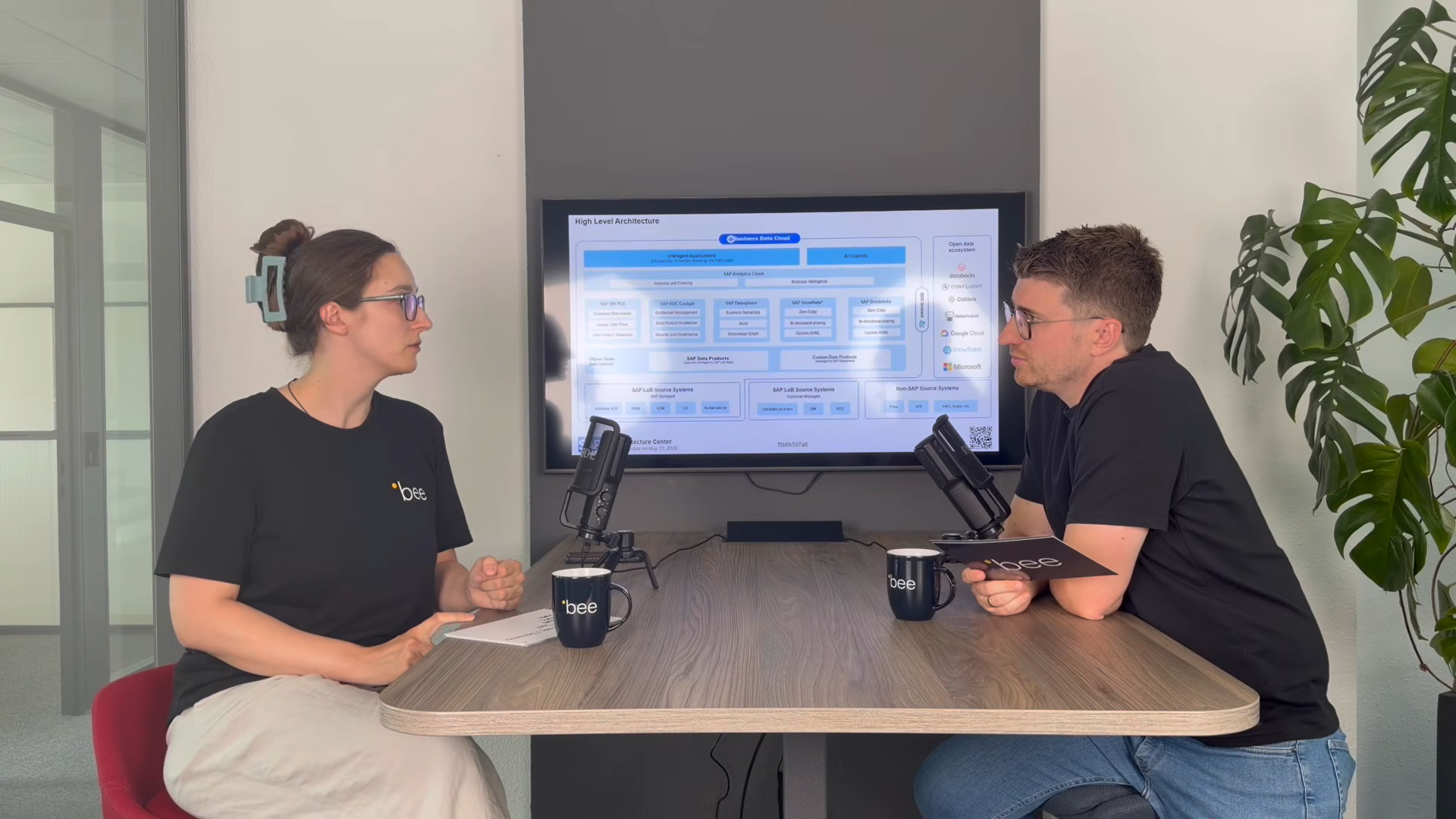
<p style="text-align: left;">Ein “SaaS-Big-Bang” fand am 13. Februar statt, als SAP während seines Events Business Unleashed den Go-live der neuen <a href="https://www.sap.com/germany/products/data-cloud.html">SAP Business Data Cloud (BDC)</a> als Teil der <a href="https://www.sap.com/germany/products/business-suite.html">SAP Business Suite</a> verkündete. Damit sollen sich alle Daten – sei es von SAP oder Drittanbietern – vereinheitlichen und verbinden lassen, geschäftskritische Erkenntnisse somit schneller erfolgen können und parallel eine zuverlässige und zukunftsfähige Künstliche Intelligenz (KI) gefördert und umgesetzt werden.</p>
<p style="text-align: left;">Oder anders und konkreter formuliert: Nutzer erhalten mit der SAP Business Data Cloud eine integrierte SaaS-Plattform, die das teils bunte Sammelsurium an Systemen wie unter anderem SAP Analytics Cloud (SAC), Business Warehouse (BW) oder auch Datasphere endlich auf einer Plattform integriert und Anwendern kosten- als auch zeitintensive Integrationsprozesse spart.</p>
</div>
</div>
</section>
<section style="background-color: #f2f5f8; width: 100%; margin-top: 0px; margin-bottom: 20px;">
<div class="custom-container" style="background-color: transparent;">
<div class="offset-block">
<h2 style="text-align: left;">Turn insights into action: instantly!</h2>
<p style="text-align: left;">Warum die SAP Business Data Cloud (abgesehen vom Platinum-Ziel KI) auch heute schon für mittelständische Unternehmen wichtig ist und wichtig sein wird: Die Plattform hilft ihnen dabei, ihre Daten besser zu verstehen und fundierte(re) Entscheidungen zu treffen – denn sie ermöglicht es ihnen, quasi en passant eine zentralisierte Datenstrategie und ein hocheffizientes Daten-Management umzusetzen, indem die Informationen aus verschiedenen Quellen zusammengeführt werden: Hier wachsen Business Analytics und Data Science endlich zusammen.</p>
</div>
</div>
</section>
<section style="background-color: #f2f5f8; width: 100%; margin-top: 0px; margin-bottom: 20px;">
<div class="custom-container" style="background-color: transparent;">
<div class="offset-block">
<h2 style="text-align: left;">Gehören bald der Vergangenheit an: Integrationsdefizite und ‑aufwände</h2>
<p style="text-align: left;">Ein großer Vorteil gerade für den Mittelstand, der oftmals noch mit heterogenen IT-Systemlandschaften und isolierten Datensilos zu kämpfen hat: Anstelle Daten manuell zusammenzutragen und unterschiedliche Systeme mühselig zu integrieren, können sie ihre Daten jetzt in einer einzigen Cloud bündeln und so deutlich effizientere Geschäftsprozesse umsetzen – sprich, das Daten-Silo-Problem wird gelöst, ohne Daten bewegen zu müssen. Wir bei Innovabee sind überzeugt: Diese Integration verschiedener Systeme wird das Daten-Management revolutionieren!</p>
</div>
</div>
</section>
<section style="background-color: #f2f5f8; width: 100%; margin-top: 0px; margin-bottom: 20px;">
<div class="custom-container" style="background-color: transparent;">
<div class="offset-block">
<h2 style="text-align: left;">Erste Use Cases: intelligente Analysen für Finance, Lieferketten, Beschaffung & Co.</h2>
<p style="text-align: left;">Wie genau der praktische Mehrwert aussehen kann, zeigen folgende Beispiele: Leistungsstarke Analysefunktionen ermöglichen es, nicht nur historische Daten auszuwerten, sondern dank integrierter KI (Stichwort SAP Business AI) lassen sich auch künftige Trends vorhersagen – sei es in der Produktion, im Vertrieb oder im Finanz-Management. Echtzeitauswertungen und ‑leistungsüberwachung für die Finanz-Teams? Optimierte Compliance- und Audit-Prozesse auf einer einheitlichen Datenplattform? Eine KI, die Planungs- und Ausführungsfunktionen innerhalb der Supply Chain optimiert?</p>
<p style="text-align: left;">Gerade für mittelständische Unternehmen sind schnelle und intuitive Prozesse mit kontextbezogenen Daten und einer KI, die in Business-Apps integriert ist, von unfassbarem Wert. Und noch eine gute News: Dank der von SAP angekündigten <strong>AI Agents</strong> lässt sich die AI nahtlos auf die Business-Daten anwenden – und all das im gewohnten SAP-Umfeld. Die native Integration von Data Bricks <a href="https://youtu.be/oG-YaIlIj-4?t=19">schließt dann die Lücke zwischen unstrukturierten und strukturierten Daten</a>, eine „seamless“ Governance, höchste Sicherheitsstandards sowie bis dato nicht dagewesene Offenheit und Flexibilität inklusive.</p>
<p style="text-align: left;"><strong>Unser Fazit:</strong> Die SAP Business Data Cloud liefert ein starkes Fundament, gerade für den Mittelstand, der damit datengestützte Entscheidungen auf Enterprise-Niveau treffen und wettbewerbsentscheidende Grundlagen für die Zukunft schaffen kann.</p>
</div>
</div>
</section>
</div>
Sie wollen keine News mehr verpassen? Dann abonnieren Sie unseren Newsletter:
Weitere Beiträge
SAP Business Data Cloud
SAP Business Data Cloud: Plattform statt weiteres Tool
08.10.2026
|
SAP Cloud ERP

SAP Release-Upgrade bei Dallmayr
25.09.2026
|
Kundenreferenzen

Innovabee ist offizieller SAP-Concur-Implementierungspartner
16.09.2026
|
Innovabee